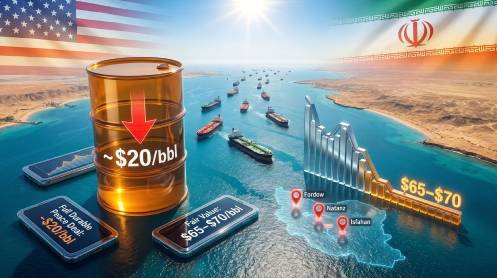
SINGAPORE: Global oil prices fell more than 5 percent on Monday after the United States and Iran paused military strikes over the weekend, raising hopes for a diplomatic breakthrough that could ease regional tensions and restore shipping through the strategic Strait of Hormuz.
Brent crude futures dropped $4.89, or 5.05 percent, to $91.89 per barrel by 0009 GMT, briefly falling below the key $90 support level during early trading. Meanwhile, US West Texas Intermediate (WTI) crude declined $4.67, or 5.23 percent, to $84.64 per barrel.
Both benchmark contracts touched their lowest levels in nearly a week, reversing gains made over the previous three weeks amid escalating geopolitical tensions.
Last week, Brent crude had climbed to $100 per barrel as the conflict disrupted oil shipments through the Strait of Hormuz and spilled into the Red Sea, affecting exports from Saudi Arabia via the Bab el-Mandeb Strait.
The shift in market sentiment followed comments by US Ambassador to the United Nations Mike Waltz, who told Fox News Sunday and other US media outlets that President Donald Trump had decided to pause US military operations to allow more time for diplomatic efforts.
Market analysts said the temporary halt in hostilities has improved investor confidence.
“Hopes are rising that a genuine diplomatic path may be opening,” said Tony Sycamore, market analyst at IG.
He added that renewed engagement based on the previously proposed 14-point memorandum of understanding (MoU), along with greater clarity over navigation through the Strait of Hormuz, would provide a positive foundation for de-escalation.
Despite the pause in military action, shipping activity remains subdued. According to vessel tracking data from Kpler, fewer than 10 commodity vessels per day transited the Strait of Hormuz over the weekend, highlighting continued caution among global shipping operators.
Traffic through the Bab el-Mandeb Strait also declined on Sunday after Yemen’s Houthi forces reportedly attacked Saudi oil facilities along the Red Sea coast, although a third Chinese supertanker successfully passed through the waterway.
Analysts cautioned that a full recovery in maritime traffic is unlikely to happen immediately.
“Any rebound in flows through the Strait of Hormuz is likely to be gradual and only partial, as many shipping companies will seek stronger assurances over safety before resuming normal operations,” said Saul Kavonic, analyst at MST Marquee.
While the diplomatic pause has eased immediate concerns over supply disruptions, energy markets remain sensitive to developments in the Middle East, with investors closely monitoring whether the ceasefire efforts can lead to a more lasting resolution.
By Reuters